
Crack Your Kubernetes Interview — With Detailed Solutions
156 real production scenarios — master the failures that actually get asked, and walk in ready for any question.
Powered by Razorpay
Secure 256-bit SSL checkout. Instant signed PDF download.
Included in this Bundle Pack:
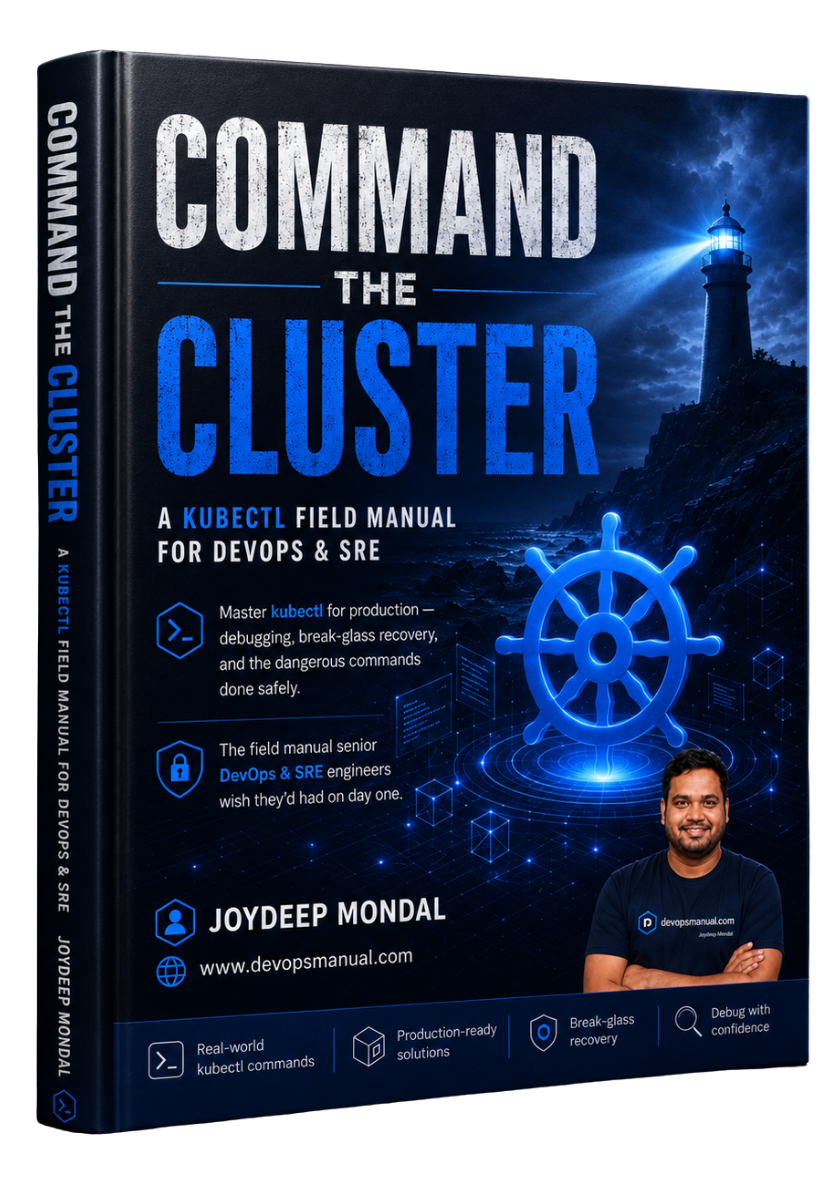
Command the Cluster — Master kubectl for Production
Stop Googling the same kubectl commands at 3 AM.
A free cheat sheet is just command → description. What you can't Google is the judgment around the command — when to reach for one over another, how to read output that matters, and the gotchas you only learn on-call.
Build Unshakeable Confidence
Stop memorizing dry, theoretical definitions. This handbook puts you in the driver’s seat of 156 real-world production outages. You’ll learn how to think, debug, and speak like a Principal SRE under pressure, tracing failures down to the kernel sockets.
The Cost of Missing Out
Tech panels are no longer asking basic questions like "What is a replica set?"—they are presenting live, multi-failure outages. Without this book, you will miss the deep-dive debugging workflows that separate senior architects from junior developers.
Here's How This Book Gets You Hired
When an interviewer asks a Kubernetes question, they're not testing what you memorized — they're testing how you think. Most candidates freeze, guess, or recite definitions. This book teaches you to answer like someone who's actually been on-call.
Every one of the 156 scenarios trains you the same way
By the end, you don't memorize answers — you build the instinct to reason through any Kubernetes problem they throw at you. Even the ones not in the book.
Why this is NOT another generic Q&A eBook
100% Production Incident Focus
No textbook definitions. Every question represents a real production outage based on CoreDNS limits, conntrack exhaustion, and etcd split-brain behavior.
Junior to Senior Difficulty
Scenarios are tagged by level. Learn how junior commands differ from deep kernel-level analysis expected of Staff SRE and Principal Infrastructure roles.
Full Playbook Solutions
Every outage includes the symptoms, the alerts that triggered, the exact diagnostic commands (`kubectl`, `lsof`, `nslookup`), the fix, and senior engineering insights.
Gain access to all 156 production-grade scenarios and interview playbooks
Powered by Razorpay
Explore the 156 Production Scenarios
Click on the chapters below to inspect the real-world troubleshooting syllabus included in this handbook.
-
Junior Pending for 20 Minutes, and
describeShows Nothing - Junior Restarts Every 90 Seconds, Logs Are Clean
-
Junior
ImagePullBackOff, but the Image Definitely Exists - Mid-Level 7 of 10 Replicas Schedule, Nodes Have Plenty of CPU
-
Mid-Level Schedules in dev , Pending in prod , Same
YAML -
Mid-Level
Init ContainerFinishes, Main Container Never Starts -
Mid-Level Added a
nodeSelector, Pods Stopped Scheduling, but the Label Exists -
Mid-Level The
CronJobThat Silently Stopped Running at Midnight - Senior Pod Is Running and Ready, but the App Hasn't Actually Started
- Senior Pods Evicted in a Loop, and It's the Descheduler Doing It
-
Senior
Topology Spread ConstraintsMade the Rollout 4x Slower - Senior After a Node Failure, Anti-Affinity Pods Ended Up on the Same Node
- Senior Cluster Autoscaler Adds Nodes, but the Pods Stay Pending
- Junior Works From One Pod, Times Out From Another, Same Namespace
- Junior Every DNS Lookup Suddenly Takes 5+ Seconds
-
Junior Endpoints Exist,
ClusterIPSays Connection Refused - Mid-Level DNS Dead Only for Pods on Two Specific Nodes
- Mid-Level Intermittent NXDOMAIN for Services That Exist, Right After a CoreDNS Upgrade
- Mid-Level Pod-to-Pod Works, Pod-to-Service Works, Node-to-Service Fails
- Mid-Level The Egress Policy That Took Out DNS
-
Mid-Level
ConntrackIs at 40%, So Why the Random Timeouts? -
Senior The Infamous 1-in-N DNS Timeout: UDP,
Conntrack, and a Kernel Race -
Senior After the
CNIMigration, Every New Pod Is Born Dead - Senior Headless Service, Stale IPs, and the 30-Second Window of Errors
- Senior Small Requests Fine, Uploads Hang: The 1400-Byte Cliff
-
Senior
IPVSSays the Pod Is Gone. The Traffic Disagrees.
-
Junior The
PVCandPVThat Refuse to Marry - Junior Node Dead, Volume Hostage: "Already Exclusively Attached"
-
Mid-Level
PVCDeleted by Accident: Is the Data Gone? - Mid-Level Mounted Fine, Permission Denied on Every Write
- Mid-Level The Volume That Wouldn't Cross the Street (AZ Affinity)
- Mid-Level 60% Free, and Yet: No Space Left on Device
-
Mid-Level You Resized the
PVC. The Filesystem Didn't Get the Memo. -
Senior One
RWOVolume, Two Nodes, Both Writing -
Senior The
CSIController Got Evicted, and the Whole Cluster Felt It - Senior Every Snapshot Succeeds. Every Restore Is Corrupt.
- Senior The Drain That Ate the Upgrade Window
- Senior The Backup That Mugs the Database Every Night at Two
-
Senior
kubectl delete pvon a Bound Volume: The Bomb With No Bang
- Junior The Role That Lists Deployments and Grants Nothing
-
Junior
can-iSays Yes. The API Server Says Forbidden. Both Are Right. -
Mid-Level The Developer Who Can Read
SecretsNobody Gave Them - Mid-Level One Secret, Two Truths: The Rotation That Split the Fleet
-
Mid-Level The Auditor's Question: Who Can
ExecInto Production? - Mid-Level The Default Token Nobody Can Explain
- Senior The Admission Webhook That Took the Cluster Hostage
- Senior The Privileged Pod That Nobody Owns
-
Senior The Departed Contractor's
Kubeconfigon a Public Repo - Senior "Encrypted at Rest," and the Node Compromise That Read Everything Anyway
- Senior From One Pod to cluster-admin: Reconstruct the Path
-
Senior restricted Broke the One
DaemonSetThat Needs Root - Senior The CVE That Passed the Scan and Shipped Anyway
-
Junior
OOMKilled, but the Graph Never Touched the Limit -
Junior The
JVMThatOOMKillsat 2Gi With -Xmx Set to 1.5Gi - Mid-Level The CPU Limits Added "For Safety" That Doubled p99
- Mid-Level Node Goes NotReady, Everything Evicts — Except One Pod
- Mid-Level Evicted for ephemeral-storage Nobody Requested
- Mid-Level Guaranteed QoS, Evicted First: Why Didn't It Save Me?
- Mid-Level The 6-Hour Leak That Pages On-Call Every Night at 3
-
Senior The Kubelet
OOMsBefore the Pods Do, and the Node Dies -
Senior
VPARecommendations That Oscillate and Churn the Pods - Senior One Pod's Spike, Three Nodes of Cascading Evictions
-
Senior
HPAAdds Pods, Throughput Stays Flat, the Bill Goes Up -
Senior
cgroupv2 Changed the Rules, and Pods That Survived for Years Now Die - Senior Requests Without Limits, Limits Without Requests, or Both Equal: Defend One
- Junior Node NotReady: Your First Five Commands
-
Junior
kubectl drainHangs Forever - Mid-Level Kubelet Upgrade Restarted Every Pod. Should It Have?
-
Mid-Level
PodDisruptionBudgetSet, and the Rolling Upgrade Still Caused an Outage -
Mid-Level Clock Skew on One Node, Intermittent
TLSFailures - Mid-Level The Node That Passes Every Health Check and Poisons Every Pod
-
Mid-Level
etcdDisk Latency Alerts, and the Whole Cluster Feels Slow - Senior The Upgrade Succeeded. A Week Later, Workloads Started Failing.
-
Senior Upgrade a 3-Node
etcdCluster Under Live Traffic, Zero Downtime -
Senior Restored
etcdFrom Backup, and the Cluster Slowly Diverges From Reality -
Senior Kernel Upgrade Silently Broke the
CNI'seBPFPrograms - Senior A Certificate Expired at 2 AM and the Kubelets Can't Talk to the API Server
- Senior Designing a Node Lifecycle for a 24x7 Platform With No Maintenance Window
-
Junior
IngressReturns 404, but the Service and Pods Are Healthy - Junior HTTPS Works, HTTP Won't Redirect, and the Annotation Is Right There
- Mid-Level Intermittent 502s the Backend Never Sees
- Mid-Level Scaled From 3 to 30 Pods, Traffic Still Hits the Original 3
-
Mid-Level
WebSocketConnections Drop Exactly Every 60 Seconds - Mid-Level The Canary That Logs Users Out
- Mid-Level Every Client IP Shows Up as the Node's IP
- Senior The 502 Burst on Every Rolling Deploy
-
Senior
kube-proxyUpdate Marks Every Node Unhealthy, Whole Cluster Goes Dark -
Senior
TLSHandshake Latency Spikes Under Load, App Latency Flat -
Senior Two
IngressControllers, OneIngress, Endless Flapping -
Senior Traffic Must Never Leave the Country: Designing Sovereign
Ingress -
Senior Migrating
IngresstoGateway APIon a Live Emergency-Services Platform
- Junior db-1 Is Stuck Pending While db-0 and db-2 Run Fine
-
Junior Scaled a
StatefulSetDown From 5 to 3: Where Did the PVCs Go? -
Mid-Level A
StatefulSetRolling Update That Just... Stops Halfway - Mid-Level Primary Rescheduled, Replica Promoted, Writes Lost
-
Mid-Level
KafkaBroker Restarts, Rejoins, and Is Useless for 40 Minutes -
Mid-Level
Postgresin Kubernetes Is 30% Slower Than the SamePostgreson a VM - Mid-Level "Would You Run a Production Database on Kubernetes?"
- Senior Quorum Lost on a Drain, and the PDB Was Correct
- Senior Post-Restore: Right Volumes, Wrong Identities
-
Senior
RedisClusterCLUSTERDOWNDuring UnrelatedHPAScaling - Senior The Operator Upgrade That Reconciled Your Databases Into a Broken State
- Senior Designing Backup, Restore, and DR-Failover With a 5-Minute RPO
- Senior Force-Deleted Pod Comes Back While the Old Container Is Still Writing
- Junior The Pod Crashed Overnight and the Logs Are Already Clean
-
Junior
kubectltop andGrafanaDisagree, Violently -
Mid-Level
PrometheusIs Dropping 5% of Scrapes, Randomly -
Mid-Level
ELKIngests Logs With a 10-Minute Delay, but Only at Peak -
Mid-Level The Pod You Can't
exec, Log, or Port-Forward — but It Serves Traffic Fine - Mid-Level One Node Failed, 200 Alerts Fired
- Mid-Level Capture One Pod's Traffic for 60 Seconds Without Touching Its Image
- Senior p99 Tripled and Every Dashboard Is Green
-
Senior
PrometheusMemory Doubled After a Deploy That "Only Added One Metric" - Senior Debugging a Distroless Container With No Shell
-
Senior
GrafanaSays 14:32, Logs Say 14:38, Traces Say 14:29 -
Senior The Logging
DaemonSetBecame the Noisy Neighbor - Senior Debugging Live Healthcare Traffic With Zero PII in the Logs
- Junior The Rollout Stuck at "1 old, 1 new" That Never Progresses
- Junior Jenkins Says "Deploy Succeeded," Production Runs the Old Code
- Mid-Level A Node Restart Silently Changed Which Code Is Running
- Mid-Level Rollback Restored the Pods, but the Incident Continued
- Mid-Level The Manual Edit That Keeps Reappearing After Every Deploy
- Mid-Level Passed Every Check at 6 PM, Error Rates Climbed at 9 PM
- Senior Two Pipelines Deployed to the Same Namespace Seconds Apart
-
Senior
GitOpsand akubectledit Flapping a Service Every Three Minutes -
Senior
HelmUpgrade Failed Halfway, andhelmrollback Also Fails - Senior The Canary Passed at 5%, the Full Rollout Failed
- Senior 17 Pipelines, One Mid-Chain Failure, Incompatible Versions Live
-
Senior The Migration Ran in an
Init Container, the Deploy Rolled Back, the Schema Didn't - Senior "Walk Me Through a Deploy You Shipped That Caused an Outage"
- Junior "Exceeded Quota" When the Namespace Shows Free Quota
-
Junior
LimitRangeApplied, Existing Pods Fine, New Pods Rejected - Mid-Level One Team's Batch Jobs Slow Every Other Tenant, Same Hour Daily
- Mid-Level A Tenant Claims They Can See Another Tenant's Services via DNS
-
Mid-Level
ResourceQuotaBlocked a Critical Production Deploy at the Worst Moment - Mid-Level Two Tenants, Two Different Pod Security Levels, One Cluster
-
Mid-Level A Misconfigured
HPAScaled to 200 Pods and Starved the Cluster - Senior The Tenant's Operator Is Watching the Whole Cluster
- Senior PriorityClass Abuse: One Team Set system-cluster-critical
-
Senior
NetworkPolicyIsolation Exists, but the Pen Test Got Cross-Tenant Data Anyway - Senior One Tenant's Controller Hammers the API Server, Everyone Slows Down
- Senior Namespaces or Cluster-Per-Tenant for 12 Government Departments?
- Senior Designing Chargeback Nobody Can Dispute
- Mid-Level 3 AM, a National Helpline's Call-Routing Degrades During a Crisis Spike
- Mid-Level A 40-Second Network Blip, a 25-Minute Recovery
- Mid-Level Reverse Engineering a Legacy Platform: Zero Documentation, Original Team Departed
- Mid-Level Prove No Production Change in 6 Months Bypassed Review
- Mid-Level The "Standby" Was Three Config Versions Behind
- Senior The 2 AM Page Where Restarting "Fixes" It for 40 Minutes
- Senior A Slow Upstream Gateway Takes Down Unrelated Endpoints
- Senior Festival Day: 8x Traffic on a Cluster Sized for 3x
- Senior Keycloak Token Validation Takes Down "Independent" Microservices
-
Senior
APISIXConfig Propagation Delay Misrouted Healthcare Traffic - Senior The Monitoring Stack Went Down at the Same Moment as the Incident It Should Have Caught
- Senior Leadership Demands "Zero Downtime, Ever" on a Budget With No Second Cluster
- Senior The Final Boss: A 6-Hour Outage on a Citizen-Facing Service, Write the Postmortem
Master real-world etcd recovery, conntrack race conditions, and RBAC security
Powered by Razorpay
High-Value Production Scenarios Covered
Whether you are a Kubernetes beginner or an experienced engineer, this handbook bridges the gap between basic tutorials and the actual complex issues you will face in live production and coding interviews. We don't just teach you syntax—we explain how systems break, what interviewers want to hear when they test you, and how to fix them like a senior architect.
Scenario 9 (Chapter 12): What happens when your central login server slows down and instantly brings down every service in your cluster? Learn how central authentication becomes a Single Point of Failure (SPOF) and how local JWT signature validation with cached JWKS public keys decouples them.
Scenario 10 (Chapter 12): Why did a simple, successful routing update send customer traffic to the wrong system? Learn to diagnose config sync delays and propagation latency between Apache APISIX gateway nodes that cause mismatched routing rules during a rollout.
Scenario 1 (Chapter 5): Why do your monitoring charts show plenty of free memory, but the container suddenly crashes anyway? Learn how Prometheus average calculations hide short, instantaneous memory spikes, and how to read the kernel's raw oom_score_adj and dmesg logs.
Scenario 2 (Chapter 5): You set your Spring Boot Java application's limit to 1.5GB, so why does the system terminate it at 2GB? Learn the hidden secrets of "off-heap" overhead (Metaspace, thread stacks, GC garbage collector metadata) and how to configure limits without throwing away budget.
Scenario 8 (Chapter 5): When your apps use too much resource, they can starve the server's own control agent (the Kubelet), causing the server to freeze and crash-loop. Learn how node-allocatable options reserve safe space for system daemons.
Scenario 9 (Chapter 2): Why are some API requests randomly taking exactly 5 seconds longer than normal? We demystify the Linux kernel's parallel UDP socket connection tracking (conntrack) race condition and show why NodeLocal DNSCache is the definitive fix.
Scenario 11 (Chapter 6): Why did a simple operating system upgrade silently disable your routing and security policies? Learn how upgrading the Linux kernel can cause the Cilium CNI network manager to fail back to slower legacy routing paths when BPF verifiers reject older program rules.
Scenario 13 (Chapter 8): Forcefully deleting a stuck database pod seems like an easy fix, but it can create an invisible "ghost container" that keeps writing to the same disk as its replacement. Learn how this causes dual-writer storage corruption and how to prevent it.
Scenario 9 (Chapter 9): Adding a single user ID label to your metric tracking seems innocent, but it can combinatorially expand your database size from 1.2M to 4.8M series, crashing Prometheus. Learn how to locate metric explosions and apply clean drop rules.
Scenario 8 (Chapter 10): What happens when an on-call engineer makes an emergency kubectl edit to resolve an incident, only for ArgoCD's automated selfHeal loop to detect drift and revert the setting three minutes later, causing a prolonged flapping outage.
Scenario 1 (Chapter 1): Learn why a newly deployed pod sits Pending for 20 minutes with its describe events completely empty. Trace how simple scheduler name typos bypass the active scheduler loop entirely, leaving pods unassigned without errors.
Scenario 6 (Chapter 1): What prevents the main application container from launching even after the init containers report successful completion. Understand dependency startup sync, race conditions, and kubelet state deadlocks.
Scenario 10 (Chapter 1): Investigate why pods are evicted continuously in a rolling disruption loop. Diagnose conflicting placement rules where the K8s descheduler tries to balance utilization while the default scheduler keeps repopulating.
Scenario 2 (Chapter 2): Why all DNS lookups suddenly take 5+ seconds after a routine node rollout. Learn how to verify resolver configuration failovers and prevent DNS caching agent routing bypasses.
Scenario 12 (Chapter 2): Troubleshoot a network issue where small API queries work perfectly but large payload file uploads hang indefinitely. Understand PMTU discovery failures and overlay network (VXLAN/GENEVE) encapsulation headers.
Scenario 2 (Chapter 3): A node fails, but the rescheduled database pod gets stuck Pending indefinitely. Learn how read-write-once (RWO) cloud block volumes remain held hostage on the crashed host, and how to safely release attachments.
Scenario 6 (Chapter 3): Why writes fail with "No space left on device" despite disk monitoring showing 60% free capacity. Trace how large volumes of small temporary files exhaust the filesystem's inode table, and how to clear it.
Scenario 13 (Chapter 3): What happens when an administrator accidentally executes kubectl delete pv on a bound persistent volume. Understand protection finalizers, block volume lockouts, and recovering orphaned physical disks.
Scenario 7 (Chapter 4): How a minor code crash in a validating admission webhook shuts down all namespace deployments. Learn how to recover a locked control plane by bypassing validating calls during emergencies.
Scenario 3 (Chapter 5): How configuring CPU limits for safety can double p99 response times while average utilization stays below 20%. Understand Linux kernel CFS bandwidth quotas and how to identify CPU throttling spikes.
Scenario 12 (Chapter 5): Workloads that ran stably for years suddenly crash-loop after node OS updates upgrade the runtime to cgroup v2. Understand how memory pressure calculations and OOM behaviors differ.
Scenario 5 (Chapter 6): Trace how minor NTP clock drift on a single cluster node causes intermittent TLS handshake failures and cross-pod token validation rejections that pass basic container smoke tests.
Scenario 7 (Chapter 6): Analyze how microsecond disk write latency spikes on the control plane's etcd nodes trigger cascades of slow API requests and pod scheduling stalls. Learn how to isolate etcd WAL writing paths.
Scenario 9 (Chapter 6): Step-by-step instructions to upgrade a 3-node etcd cluster under live load. Learn how to verify state synchronization and peer member alignment to prevent cluster partition.
Scenario 8 (Chapter 7): Brief bursts of 502 Bad Gateway errors on every rolling deployment. Trace how connection draining, endpoint synchronization lags, and proxy configuration update delays cause traffic drops.
Scenario 13 (Chapter 2): Kube-proxy IPVS says a deleted pod is gone, but active user connections keep getting routed to it, failing. Understand the IPVS TCP connection persistence templates and timeouts.
Scenario 5 (Chapter 8): Why a restarted Kafka broker pod takes 40 minutes to serve traffic again. Diagnose block device mount synchronization, un-checkpointed log segments, and JVM page faults under load.
Scenario 9 (Chapter 10): A deployment fails midway, leaving a Helm release in a FAILED state, and subsequent rollbacks are rejected due to three resource definition conflicts. Learn how to clean Helm release secrets.
Scenario 9 (Chapter 11): A tenant developer sets their application priority to system-cluster-critical. Trace how this causes CoreDNS and Ingress controller pods to be evicted during node resource pressure.
Scenario 2 (Chapter 12): A minor 40-second network interruption results in a 25-minute system recovery outage. Learn how mass reconnection surges trigger cascading connection pool and authentication bottlenecks.
Who is This Book For?
This guide is not a beginner's introduction. It is built for engineers looking to master advanced Kubernetes operations and SRE troubleshooting patterns.
The Job Candidate
Preparing for DevOps, SRE, or Platform Engineer interviews. Stand out by answering with real-world diagnosis workflows instead of memorized definitions.
The Mid-Level SRE
Bridge the gap between "I can run basic kubectl commands" and "I know the structural design decisions required to run 24x7 citizen-facing clusters safely."
The On-Call Engineer
Build a deep mental repository of production failure modes and warning signs. Troubleshoot and restore critical services in minutes rather than hours.
The Tech Lead
Design realistic SRE scenario assessments and technical interview questions to test candidates' practical problem-solving capabilities.
What Value This Book Adds to Your Career
Most books stop at local minikube setups. This book focuses entirely on production-grade systems, SRE failure telemetry, and kernel-level network behavior.
-
156 Real Production Incidents
No generic syntax descriptions. You get real scenarios built from live outages, with logs, YAML manifest errors, and diagnosis workflows.
-
Step-by-Step Diagnostic Frameworks
Learn exactly which diagnostic commands to run first, second, and third. Stop random guessing and start systematic tracing.
-
Architectural Prevention Insights
Every scenario includes a senior-level review detailing how to architect the cluster and applications to prevent the failure from ever recurring.
SRE Diagnostics Skill Matrix
Designed by SREs for high-velocity platform engineers
Powered by Razorpay
How This Book Helps You Ace Interviews
Senior DevOps and SRE interviews are designed to bypass theoretical concepts. Interviewers want to see how you think under pressure.
Deconstruct Scenario Questions
Interviewers often ask open-ended questions like: "A service has a 5-second DNS latency lookup spike under load. How do you find the cause?" Learn to identify the underlying netfilter conntrack race conditions they are looking for.
Structured Resolution Thinking
Show senior engineering competency by moving systematically from Symptoms, through Diagnostic Commands, to Root Cause, Remediation Manifests, and Prevention Architecture.
The "Tell Me About an Outage" Question
Be fully prepared for the most common senior behavioral question: "Walk me through a production failure you caused or handled, and the postmortem." Use Chapter 12's citizen-facing war stories as perfect study templates.
What Readers Are Saying
Real feedback from software engineers, SREs, and DevOps professionals who read the handbook.

"One of the best Kubernetes resources I've come across. Instead of textbook theory, it walks you through real production failures the way an experienced engineer actually thinks. The diagnosis steps and senior-level insights are the kind of thing you only learn from years on-call. A genuinely valuable read for DevOps and SRE engineers. One-Liner: Real production thinking, not textbook theory."

Frequently Asked Questions
Have questions about the handbook? Find quick answers below.
Download the dynamic watermarked SRE handbook instantly
Powered by Razorpay
Sample Scenario Sneak Peek
Take a look at how real production incidents are documented and resolved in the handbook.
Incident Report: Scenario 2.2
Every DNS Lookup Suddenly Takes 5+ Seconds
5000ms for service discovery lookups, but CoreDNS CPU usage remains completely normal.
1. Execute active network latency queries from within an application container to verify service discovery timings:
2. Root Cause: This is a connection tracking race condition in the Linux kernel netfilter conntrack module when performing parallel A and AAAA DNS lookups over UDP. Under load, the kernel NAT translation drops the duplicate insertion socket request, triggering a 5-second timeout resolver fallback.
- Deploy NodeLocal DNSCache as a DaemonSet to intercept UDP DNS queries locally, bypassing the kernel conntrack NAT table entirely.
-
Minimize SEARCH paths and decrease resolver retries by tuning pod configuration: set
ndots: 1indnsConfig.

About the Author: Joydeep Mondal
Joydeep Mondal is a Senior SRE and platform engineer specializing in national-scale, citizen-facing government platforms operating 24x7 with no maintenance window. He builds resilient system boundaries and guides engineering organizations in resolving critical production incidents.
Claim Your Copy Today
Master 156 real-world outages. Learn the commands, fix the bugs, and ace your senior platform engineering interviews.
Powered by Razorpay
Limited Time Offer: 50% OFF