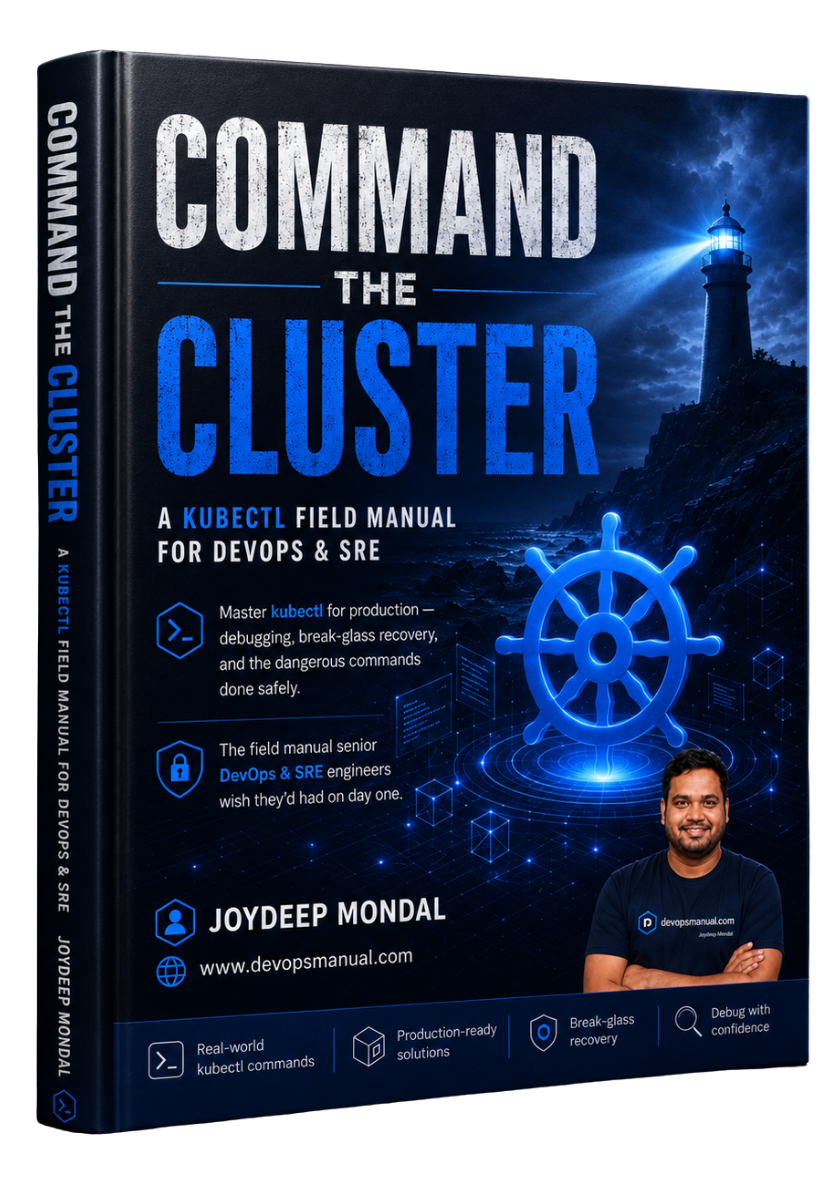
Command the Cluster — Master kubectl for Production
36 chapters of production-grade kubectl — from everyday commands to 3 AM break-glass survival. The jsonpath tricks, debugging workflows, and on-call judgment you won't find in a cheat sheet.
Powered by Razorpay
Secure 256-bit SSL checkout. Instant signed PDF download.
Not Another Cheat Sheet
This field manual gives you the judgment around the command.
Not Another Cheat Sheet
A free cheat sheet is just command → description. You can Google that. This field manual gives you the judgment around the command — when to reach for one over another, how to read the output that actually matters, and the gotchas you only learn on-call at 3 AM with a pager going off.
From Everyday Commands to Break-Glass
This manual spans the full range: basic kubectl fluency for juniors, all the way to recovering a cluster when the API server itself is down. Advanced jsonpath, ephemeral-container debugging, RBAC auditing, etcd operations, and the dangerous commands done safely.
What You'll Master
12 core production operational topics built directly into the manual.
JSONPATH MASTERY
Turn kubectl into a cluster-wide query engine.
CRASHLOOP DECODE
Read exit codes 137/143 and find the real cause.
DISTROLESS DEBUG
Debug a no-shell container with ephemeral containers.
DNS / NETWORK TRACE
Find the 5-second timeout buried in the kernel.
BREAK-GLASS
Recover a cluster when the API server is down.
RBAC AUDIT
Find who can exec into production, at scale.
SAFE FORCE DELETE
Force-delete a stuck pod without corrupting data.
ETCD OPERATIONS
Snapshot, defrag, and restore etcd safely.
FINALIZER REMOVAL
Clear a stuck namespace without orphaning resources.
NODE PRESSURE
Diagnose OOMKills and evictions at the node level.
FIRST 5 COMMANDS
The reflex sequence for every incident type.
KREW FIELD KIT
The plugins that actually matter in production.
What Makes This Different?
A cheat sheet shows you the command. This book shows you the judgment.
How Every Entry Is Built
Why This is Not a Generic Cheat Sheet
Judgment Over Syntax
Every high-value entry covers when to use it, how to read the output, and the on-call gotcha — not just what to type.
Junior to Senior
Everyday kubectl fluency through expert break-glass recovery. Every entry tagged so you know where the value is.
Dangerous Commands, Done Safely
Every destructive command is paired with its blast radius and a safe alternative. Force-delete and finalizer removal are never presented unguarded.
Gain access to all 36 chapters of production-grade kubectl and break-glass workflows
Powered by Razorpay
Explore the 36 Chapters
Click on the parts below to inspect the production-grade kubectl syllabus included in this field manual.
- Chapter 1 kubectl Mechanics
- Chapter 2 Context, Config & Productivity
- Chapter 3 Everyday CRUD
- Chapter 4 Pods & Containers
- Chapter 5 Deployments, ReplicaSets, StatefulSets & DaemonSets
- Chapter 6 Services, Endpoints & EndpointSlices
- Chapter 7 Ingress & Ingress Controllers
- Chapter 8 ConfigMaps & Secrets
- Chapter 9 Storage: PV / PVC / StorageClass / CSI
- Chapter 10 Nodes
- Chapter 11 Namespaces, Jobs/CronJobs & Quotas
- Chapter 12 RBAC & ServiceAccounts
- Chapter 13 etcd & Control-Plane Objects
- Chapter 14 Advanced Output Control & Query Mastery
- Chapter 15 jq & yq Recipes
- Chapter 16 Multi-Pod Logs & TUIs
- Chapter 17 The krew Plugin Field Kit
- Chapter 18 Node & Runtime CLIs (When kubectl Isn't Enough)
- Chapter 19 Debugging a Crashing Pod (CrashLoopBackOff)
- Chapter 20 Debugging Distroless / No-Shell Containers
- Chapter 21 Trace a Network / DNS Issue
- Chapter 22 Audit RBAC / Permissions
- Chapter 23 Investigate Node Pressure / Eviction / OOM
- Chapter 24 Recover a Stuck / Unschedulable / Pending Pod
- Chapter 25 Find What's Consuming Resources
- Chapter 26 Recover Storage
- Chapter 27 Diagnose a Slow / Overloaded API Server
- Chapter 28 Investigate a Bad Rollout / Deployment
- Chapter 29 Control-Plane Health
- Chapter 30 etcd Operations (The Safe Production Commands)
- Chapter 31 When kubectl Returns Nothing
- Chapter 32 Safe Force Operations
- Chapter 33 What NOT to Do (Outage-Causers and Safe Alternatives)
- Chapter 34 "First 5 Commands" Cards by Symptom
- Chapter 35 Decoder Tables
- Chapter 36 Copy-Paste jsonpath / jq One-Liner Appendix
Master advanced jsonpath query techniques, distroless container debugging, and quorum operations
Powered by Razorpay
High-Value Production Scenarios Covered
Whether you are a Kubernetes beginner or an experienced SRE, this manual bridges the gap between basic tutorials and complex live production operations. We don't just teach you syntax — we explain how systems break, what warning signs to monitor, and how to fix them safely.
Pull restart reasons, image inventories, and pods-without-limits across the whole cluster in one query. Plus the trait that bites everyone: jsonpath fails silently.
No shell, no tools, still broken. Use ephemeral containers to attach a debug image and inspect a container that gives you nothing to work with.
Trace a DNS timeout down to the kernel conntrack race, and know why NodeLocal DNSCache is the real fix.
When kubectl returns nothing, work the node directly with crictl and etcdctl to bring the control plane back.
137 vs 143 vs 126 vs 127 — what each one means, the 128+N arithmetic, and where to look next.
Why --force is a delete in disguise, the StatefulSet corruption it causes, and how to do it without losing data.
Why a namespace gets stuck Terminating, what the finalizer was protecting, and how to clear it without orphaning cloud resources.
Snapshot, status, defrag, and restore — the safe production commands, with the quorum math.
Use auth can-i --as and who-can to find every identity that can exec into prod or escalate to cluster-admin.
Tell OOMKilled (cgroup) from eviction (kubelet) from preemption (scheduler) — the three-layer model most people confuse.
A fixed reflex sequence for each incident type, so you don't think under pressure — you reach.
neat, tree, who-can, sniff, df-pv, node-shell — the plugins that actually earn their place on-call.
Who is This Book For?
This guide is built for engineers looking to master advanced Kubernetes operations and on-call troubleshooting patterns.
The Junior Engineer
Build real kubectl fluency fast, and learn the judgment behind the commands before you're on-call alone.
The On-Call SRE
A reflex library for incidents: the first commands, the decoder tables, the break-glass moves when kubectl stops answering.
The Senior / Staff Engineer
The signature chapters — break-glass, dangerous commands, etcd, control-plane recovery — for when you're the one others escalate to.
The Interview Candidate
The perfect companion to the scenarios book: this is the what to type, that is the how to think.
What Value This Book Adds
Most cheat sheets stop at simple command lists. This book teaches you production SRE operational judgment and safety boundaries.
-
Production-Grade, Not minikube
Real debugging workflows, real break-glass recovery, the commands you run when something is actually on fire.
-
Every Dangerous Command, Made Safe
Blast-radius notes and safe alternatives on every destructive operation. Fix the incident without causing the next one.
-
Print-and-Pin Quick Reference
The "First 5 Commands" cards and decoder tables are built to stick on your monitor for the next page.
kubectl Cheat Sheet vs. On-Call Field Manual
Designed by SREs for high-velocity platform engineers
Powered by Razorpay
Frequently Asked Questions
Have questions about the field manual? Find quick answers below.
Download the dynamic watermarked SRE handbook instantly
Powered by Razorpay
Sample Scenario Sneak Peek
Take a look at how real production incidents are documented and resolved in the field manual.
Field Manual Entry: Chapter 21 Preview
Every DNS Lookup Suddenly Takes 5+ Seconds
5000ms for service discovery lookups, but CoreDNS CPU usage remains completely normal.
1. Execute active network latency queries from within an application container to verify service discovery timings:
2. Root Cause: This is a connection tracking race condition in the Linux kernel netfilter conntrack module when performing parallel A and AAAA DNS lookups over UDP. Under load, the kernel NAT translation drops the duplicate insertion socket request, triggering a 5-second timeout resolver fallback.
- Deploy NodeLocal DNSCache as a DaemonSet to intercept UDP DNS queries locally, bypassing the kernel conntrack NAT table entirely.
-
Minimize SEARCH paths and decrease resolver retries by tuning pod configuration: set
ndots: 1indnsConfig.

About the Author: Joydeep Mondal
Joydeep Mondal is a Senior SRE and platform engineer specializing in national-scale, citizen-facing government platforms operating 24x7 with no maintenance window. He builds resilient system boundaries and guides engineering organizations in resolving critical production incidents.
Command the Cluster
Master kubectl for production — from everyday commands to break-glass recovery. The field manual senior engineers wish they'd had on day one.
Powered by Razorpay
Limited Time Offer: 67% OFF